Introduction :
Work in the year 2026 has taken a totally different dimension from that which was witnessed at the advent of the millennium. DigiWork is something that has really evolved over the past ten years, and by 2026, it is one of the most powerful forces shaping the global economy. DigiWork is income-generating work powered by digital skills, online platforms, and internet-enabled tools rather than traditional office environments. From what started off as freelancing and blogging, this has grown into an ecosystem comprising remote employment, creator economies, automation services, AI-driven solutions, and digital entrepreneurship. In the year 2026, DigiWork is no longer a career alternative; it is the mainstream choice for people in need of flexibility, independence, and scalable income. More and more companies from all over the world are depending on skilled digital workers to stay competitive in an economy driven by technology, innovation, and speed.
Why DigiWork Matters More Than Ever
By 2026, the digital economy had grown to dominate industries: from marketing and education to health and finance. The rapid development of artificial intelligence, cloud computing, and automation technologies completely changed the content of work in those times. Skills were valued more than degrees, results more than office hours, and adaptability more than rigid job descriptions. DigiWork matters because it allows you to make good money working from any location, either full-time or part-time, for diverse sources of income. For Third World countries and emerging markets, DigiWork is a way towards international income, given that skilled professionals are able to work for clients all over the world. Such a shift has had an empowering effect on businesses, unleashing talent on the world while building a truly global workforce.
The Mindset of Digiwork: Getting Ready for a Skills-Based Economy
Success in DigiWork is about more than technical skills; it’s a mindset. By 2026, digital workers must be continuous learners-constantly adapting to platform, algorithm, and technological shifts. The mindset of DigiWork is problem-focused, creative, and value-driven. Rather than finding job security in one employer, the digital worker creates skill security by diversifying their portfolio of competencies and sources of income. This mindset cultivates experimentation, personal branding, and resilience to see workers through economic flux.
High-Income DigiWork Skills in 2026
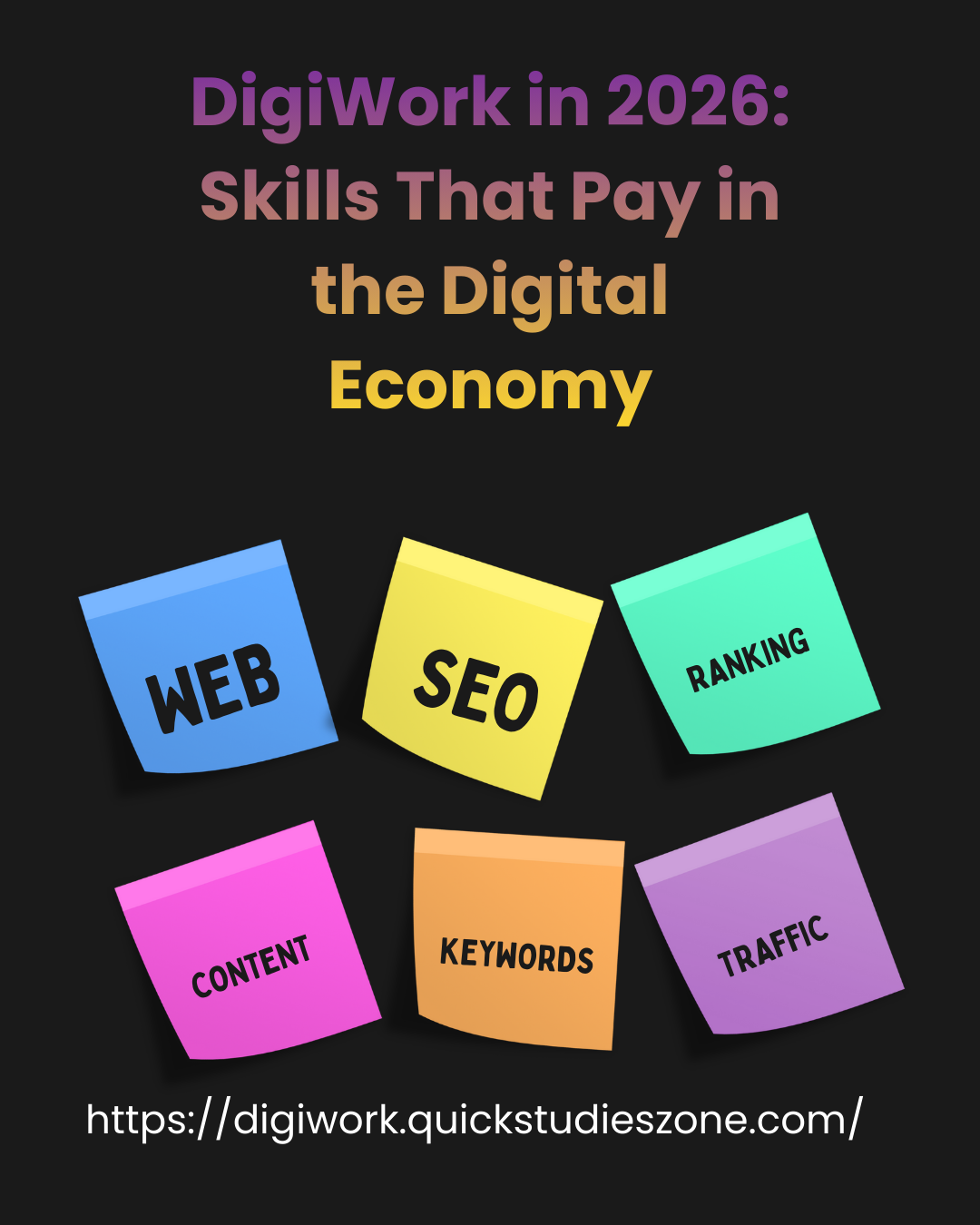
Certain digital skills are on the front burner in 2026 due to their high demand and earning potential. Among them, management of artificial intelligence tools, prompt engineering, and content creation with the help of AI have become indispensable for all industries. Digital marketing keeps improving day by day, and other high-end skills such as SEO strategy, performance advertising, conversion optimization, and data-driven marketing will keep commanding a fat pay. Web development and no-code solutions are also of great value today since the business world needs speed and cost-cutting digital products. Cybersecurity, cloud services, and data analysis continue to be among the top-paying DigiWork skills, with momentum from the increasing demand for digital protection and insight-driven decision-making.
Content Creation and the Creator Economy
The creator economy has matured substantially by 2026, and content creation is no longer a side hustle but rather a serious DigiWork career. Blogging, video creation, podcasting, and social media content will all be further integrated with monetization models-subscriptions, digital products, sponsorships, and affiliate marketing. Individuals who understand audience psychology, storytelling, and platform algorithms can make money regularly. More emphasis is being placed on niche authority than on viral fame, and creators delve into topics such as finance, health, technology, or education to engender trust for long-term revenue.
Remote Work and Freelancing in the Year 2026
While freelancing remains a cornerstone of DigiWork, it has matured into more structured and professional service-based businesses. In 2026, freelancers operate as consultants, agencies, or solopreneurs offering specialized services. Today, the accent is on verified skills, portfolios, and long-term client relationships rather than one-time gigs. The main high-paid freelance services include UX/UI design, development of applications, technical writing, SEO consulting, automation setup, and business intelligence reporting. The remote work culture also facilitated full-time digital employment for professionals to work with companies across borders.
E-commerce and Digital Entrepreneurship
Digital entrepreneurship is one of the highest paying paths to DigiWork in 2026 and will continue to expand. E-commerce businesses use AI-driven product research, automated fulfillment, and personalized marketing, scaling up effectively. The profit margins can be high through passive income with digital products such as online courses, templates, and software tools along with membership sites. Those entrepreneurs who are able to combine their technical abilities with branding and designing customer experiences within sustainable online businesses will find great success. Though entry has grown much easier, the competition has mounted, and strategy with differentiation is more key than ever.
The Role of Artificial Intelligence in DigiWork
Artificial intelligence is a central point in DigiWork 2026. AI doesn’t replace digital workers; it increases productivity and capacity. AI-driven tools help create content, design, code, analyze data, and support customers. Digital workers who learn how to integrate AI into their workflows develop a competitive edge through increased speed and quality. The most successful professionals will be those positioning themselves as AI-enabled experts who solve complex problems with the help of intelligent tools.
Learning Platforms and Skill Development
By 2026, the way DigiWork skills are learned has dramatically changed. Online learning platforms, bootcamps, and micro-certification programs for practical outcomes have come to complement traditional education systems. In addition, there is now a focus on the hands-on acquisition of competence through real-world projects and portfolio building. Communities, mentorship, and peer networks also become critical in skills development, providing the source of ongoing currency with industry developments. Continuous learning is now something akin to a life regime, necessary to be relevant in a rapidly changing economy.
Challenges in the DigiWork Economy
Of course, despite these opportunities, DigiWork is also beset by challenges in 2026. Stronger competition demands that workers make themselves stand out through quality, specialization, and personal branding. Income instability may be a problem with beginners, which makes financial planning and diversification necessary. Digital burnout is another challenge since remote work erases the boundary that separates professional life from personal. Successful DigiWorkers take care of such challenges by setting boundaries, building systems, and focusing on sustainable growth rather than short-term gains.
Building a Sustainable DigiWork Career
Sustainability is the main objective of DigiWork professionals in 2026. Instead of depending on one particular platform or client, digital workers create multiple streams of income and owned assets like websites, email lists, and digital products. Personal branding will be the cornerstone that could help one establish authority and trust with people in one’s area of specialty. By focusing on long-term value creation and continuous skill improvement, DigiWorkers can reach not only financial but also personal fulfillment.
DigiWork: What to Expect Beyond 2026
DigiWork will continue to expand with technology development and the revolution of work culture. New opportunities for digital workers will emerge with the likes of virtual reality, blockchain, and higher states of automation. Machines might get repetitive tasks, but human creativity, strategic thinking, and emotional intelligence will still be in high demand. More and more, DigiWork will be considered a lifestyle rather than a job category: free, flexible, global, and impacting. Conclusion: Skills That Truly Pay in the Digital Economy DigiWork in 2026 symbolizes the effective application of skills towards technology-oriented, innovative vocations. Paid skills solve real problems, deploy digital tools, and show measurable results. By freelancing, creating content, working remotely, or creating a digital enterprise, one can enjoy endless opportunities under DigiWork. As more and more people join the digital economy, only those with the relevant skills and attitude toward DigiWork will survive but thrive in the future.
Dgiwork: evolved over the past ten years
DigiWork is something that has really evolved over the past ten years, and by 2026, it is one of the most powerful forces shaping the global economy. DigiWork is income-generating work powered by digital skills, online platforms, and internet-enabled tools rather than traditional office environments. From what started off as freelancing and blogging, this has grown into an ecosystem comprising remote employment, creator economies, automation services, AI-driven solutions, and digital entrepreneurship. In the year 2026, DigiWork is no longer a career alternative; it is the mainstream choice for people in need of flexibility, independence, and scalable income. More and more companies from all over the world are depending on skilled digital workers to stay competitive in an economy driven by technology, innovation, and speed.
Why DigiWork Matters More Than Ever
By 2026, the digital economy had grown to dominate industries: from marketing and education to health and finance. The rapid development of artificial intelligence, cloud computing, and automation technologies completely changed the content of work in those times. Skills were valued more than degrees, results more than office hours, and adaptability more than rigid job descriptions. DigiWork matters because it allows you to make good money working from any location, either full-time or part-time, for diverse sources of income. For Third World countries and emerging markets, DigiWork is a way towards international income, given that skilled professionals are able to work for clients all over the world. Such a shift has had an empowering effect on businesses, unleashing talent on the world while building a truly global workforce.
The Mindset of Digiwork: Getting Ready for a Skills-Based Economy
Success in DigiWork is about more than technical skills; it’s a mindset. By 2026, digital workers must be continuous learners-constantly adapting to platform, algorithm, and technological shifts. The mindset of DigiWork is problem-focused, creative, and value-driven. Rather than finding job security in one employer, the digital worker creates skill security by diversifying their portfolio of competencies and sources of income. This mindset cultivates experimentation, personal branding, and resilience to see workers through economic flux.
High-Income DigiWork Skills in 2026
Certain digital skills are on the front burner in 2026 due to their high demand and earning potential. Among them, management of artificial intelligence tools, prompt engineering, and content creation with the help of AI have become indispensable for all industries. Digital marketing keeps improving day by day, and other high-end skills such as SEO strategy, performance advertising, conversion optimization, and data-driven marketing will keep commanding a fat pay. Web development and no-code solutions are also of great value today since the business world needs speed and cost-cutting digital products. Cybersecurity, cloud services, and data analysis continue to be among the top-paying DigiWork skills, with momentum from the increasing demand for digital protection and insight-driven decision-making.
Content Creation and the Creator Economy
The creator economy has matured substantially by 2026, and content creation is no longer a side hustle but rather a serious DigiWork career. Blogging, video creation, podcasting, and social media content will all be further integrated with monetization models-subscriptions, digital products, sponsorships, and affiliate marketing. Individuals who understand audience psychology, storytelling, and platform algorithms can make money regularly. More emphasis is being placed on niche authority than on viral fame, and creators delve into topics such as finance, health, technology, or education to engender trust for long-term revenue.
Remote Work and Freelancing in the Year 2026
While freelancing remains a cornerstone of DigiWork, it has matured into more structured and professional service-based businesses. In 2026, freelancers operate as consultants, agencies, or solopreneurs offering specialized services. Today, the accent is on verified skills, portfolios, and long-term client relationships rather than one-time gigs. The main high-paid freelance services include UX/UI design, development of applications, technical writing, SEO consulting, automation setup, and business intelligence reporting. The remote work culture also facilitated full-time digital employment for professionals to work with companies across borders.
E-commerce and Digital Entrepreneurship
Digital entrepreneurship is one of the highest paying paths to DigiWork in 2026 and will continue to expand. E-commerce businesses use AI-driven product research, automated fulfillment, and personalized marketing, scaling up effectively. The profit margins can be high through passive income with digital products such as online courses, templates, and software tools along with membership sites. Those entrepreneurs who are able to combine their technical abilities with branding and designing customer experiences within sustainable online businesses will find great success. Though entry has grown much easier, the competition has mounted, and strategy with differentiation is more key than ever.
The Role of Artificial Intelligence in DigiWork
Artificial intelligence is a central point in DigiWork 2026. AI doesn’t replace digital workers; it increases productivity and capacity. AI-driven tools help create content, design, code, analyze data, and support customers. Digital workers who learn how to integrate AI into their workflows develop a competitive edge through increased speed and quality. The most successful professionals will be those positioning themselves as AI-enabled experts who solve complex problems with the help of intelligent tools.
Learning Platforms and Skill Development
By 2026, the way DigiWork skills are learned has dramatically changed. Online learning platforms, bootcamps, and micro-certification programs for practical outcomes have come to complement traditional education systems. In addition, there is now a focus on the hands-on acquisition of competence through real-world projects and portfolio building. Communities, mentorship, and peer networks also become critical in skills development, providing the source of ongoing currency with industry developments. Continuous learning is now something akin to a life regime, necessary to be relevant in a rapidly changing economy.
Challenges in the DigiWork Economy
Of course, despite these opportunities, DigiWork is also beset by challenges in 2026. Stronger competition demands that workers make themselves stand out through quality, specialization, and personal branding. Income instability may be a problem with beginners, which makes financial planning and diversification necessary. Digital burnout is another challenge since remote work erases the boundary that separates professional life from personal. Successful DigiWorkers take care of such challenges by setting boundaries, building systems, and focusing on sustainable growth rather than short-term gains.
Building a Sustainable DigiWork Career
Sustainability is the main objective of DigiWork professionals in 2026. Instead of depending on one particular platform or client, digital workers create multiple streams of income and owned assets like websites, email lists, and digital products. Personal branding will be the cornerstone that could help one establish authority and trust with people in one’s area of specialty. By focusing on long-term value creation and continuous skill improvement, DigiWorkers can reach not only financial but also personal fulfillment.
DigiWork will continue to expand with technology development and the revolution of work culture. New opportunities for digital workers will emerge with the likes of virtual reality, blockchain, and higher states of automation. Machines might get repetitive tasks, but human creativity, strategic thinking, and emotional intelligence will still be in high demand. More and more, DigiWork will be considered a lifestyle rather than a job category: free, flexible, global, and impacting.
Conclusion:
Skills That Truly Pay in the Digital Economy DigiWork in 2026 symbolizes the effective application of skills towards technology-oriented, innovative vocations. Paid skills solve real problems, deploy digital tools, and show measurable results. By freelancing, creating content, working remotely, or creating a digital enterprise, one can enjoy endless opportunities under DigiWork. As more and more people join the digital economy, only those with the relevant skills and attitude toward DigiWork will survive but thrive in the future.

One thought on “DigiWork in 2026: Skills That Pay in the Digital Economy”