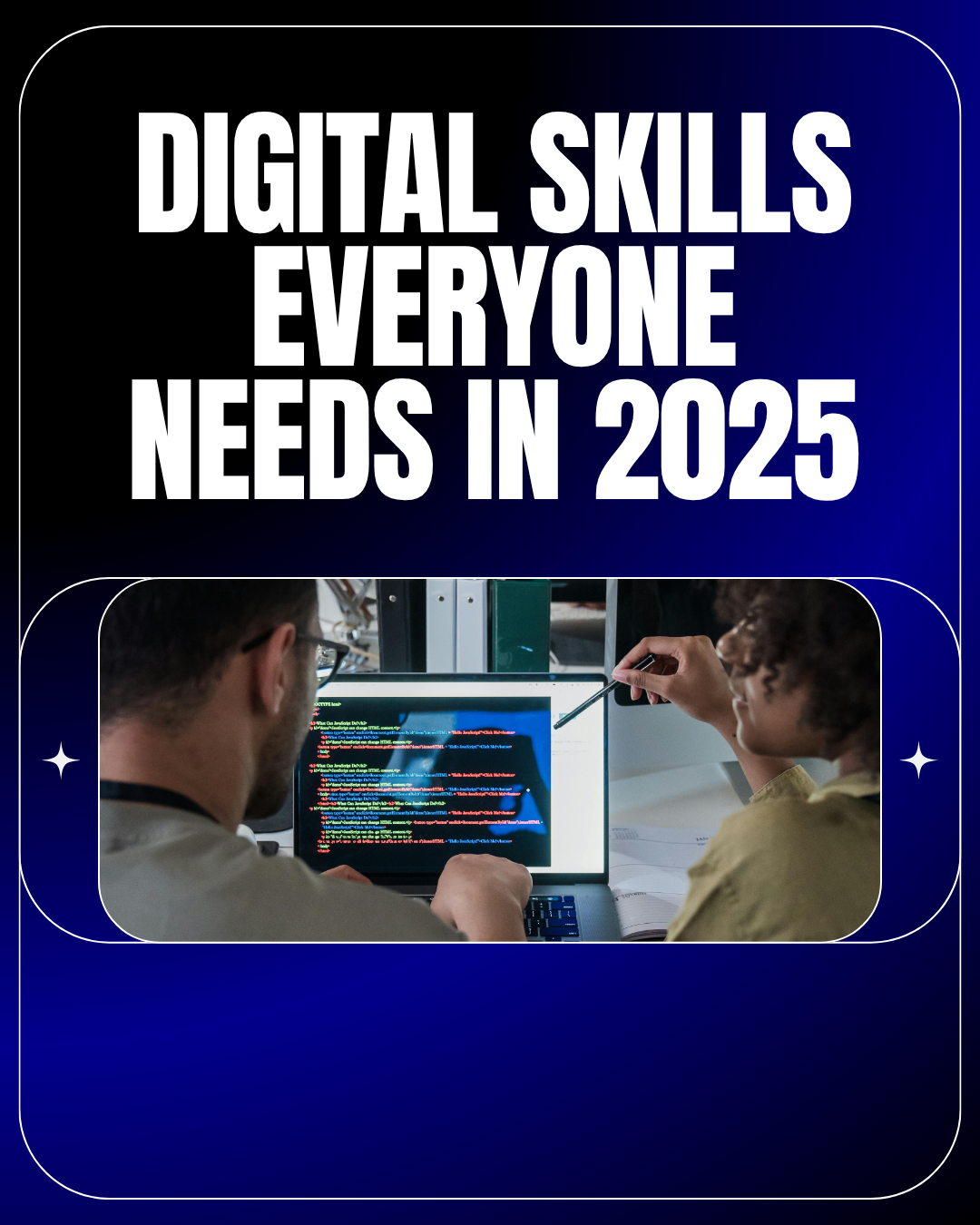
Digital Skills Everybody Will Need in 2025.
The Digital Horizon of 2025 Introduction.
The world of the future 2025 is a more digitized, interconnected and automated world than ever. The current acceleration of artificial intelligence, remote-work settings, cloud-based applications, e-commerce websites, and automation systems have established a work-place that requires every professional to be more digital savvy- whether in the industrial realm or not. Is it a student, who graduates and prepares to enter the first workforce, a freelancer, who is creating an online identity, or a company worker, who is forced to adjust to new technologies in the workplace, one thing remains certain: digital competency is no longer an option. It is the essence of money of the new opportunities.
It is no longer exclusive to the tech industry that digital transformation can happen. All industries such as healthcare, construction sector, retail, and logistics are data-driven and interconnected systems. Organizations are now requiring employees to be well versed with technology, their ability to analyze information and employ collaborative technologies as well as their ability to adjust swiftly to new technology.
Digital skills go a long way beyond the basic software knowledge in 2025. Employees now have to learn how to operate AI appliances, analyze figures, work together through the Internet, preserve their online identities, and sustain professional digital reputations. This is a long-form article that defines the key digital skills that everyone should have in 2025, gives reasons why they are important, and gives steps that can be taken to achieve them.
1. AI Literacy: Introduction to and Use of Artificial Intelligence.
AI has turned out to be the foundation of almost all modern tools, such as email assistants and productivity programs, marketing websites, and financial systems. AI does not only robots of doing the easy jobs, but is becoming more and more involved in making decisions and forecasting the results, as well as improving creative and administrative processes.
Why AI Literacy Matters in 2025
AI literacy does not imply being a machine-learning engineer. Rather it consists in knowing:
How AI tools function
What tasks they can automate
The evaluation of the AI-generated content.
Their ethical use
Limitations and risks
The ability to be AI-literate provides professionals with a competitive edge as it helps them streamline the processes, enhance accuracy, and increase creativity.
Artificial Intelligence Tools that Everybody must know.
AI writing assistants (summarizing, outlining, writing e-mails or reports)
Artificial intelligence (AI) data analysis software (trend analysis, predicting)
AI-based communication (transcription, translation, meeting note generators)
Artificial intelligence creative apps (generating images, video creation, design help, etc.)
How to Build AI Literacy
Test various AI applications.
Learn about AI ethics
Checking AI generation output.
Complete brief online generative AI courses.
Solve practice problems in your discipline.
The AI literacy is no longer an extra capability. In 2025, there is the need to be efficient and relevant.
2. Digital Collaboration Tools: How to Master the Remote-First Workplace.
Remote and hybrid work is now the norm. Even sectors that seemed to be resistant to virtual surroundings, such as medicine, education, consulting, rely on digital communication and collaboration massively.
Critical Teamwork Competencies.
The workers should be informed on how to use the tools like:
Video conferencing (Zoom, Microsoft Teams, Google Meet).
Project management systems (Asana, Trello, Monday.com, Notion).
Cloud storage systems (Google Drive, Dropbox, OneDrive)
Collaboration tools (Google Docs, Notion, collaborative PDFs)
What Digital Collaboration Will Be in 2025.
One does not have to go through the interface. Online collaboration entails:
Clear online communication
Real-time coordination
Effective task delegation
Responsibility within the common spaces.
Etiquette (muting, screen sharing, chat management)
Collaboration Skills: How to be a Better Collaborator.
Training in planning digitally.
Earn good written communication habits.
Study virtual meeting management and running.
Monitor projects by using shared workspaces.
Those individuals who are successful at digital collaboration soon ascend the hierarchy in remote-forward companies.
3. Data Literacy: Knowing and Doing With Data.
The most valuable asset in the digital world is the data. Companies use information to learn about customers, increase efficiency, uncover fraud, mitigate risk and create long-term strategy. Hence, the fact that one is able to read data, at least on the fundamental level, is crucial.
The Major data literacy elements.
Learning about data types (qualitative or quantitative)
Charts, graphs and dashboards.
Mining out insights on reports.
Perceiving tendencies and patterns.
Relying on data in decision-making.
Data Tools Everybody Should Be Familiar with.
Google Analytics
Excel and Google Sheets
Power BI or Tableau
CRM dashboards
Business intelligence reports.
Why Data Skills Matter in 2025
Organizations are placing more and more expectations on employees to:
Confirm decisions using data.
Identify inefficiencies
Measurement-based support strategies.
Monitor the performance indicators.
How to Build Data Literacy
Complete introductory courses on analytics.
Training in spreadsheets.
Test with free dashboards.
Learn to read reports in your business.
Even non-technical jobs, such as HR or sales, now require the capacity to digest an understanding that is based on data.
4. Cybersecurity Basics: Protecting Yourself and Your Organization
Wherever there’s increasing digital dependence, there’s a corresponding rise in cyber threats: phishing attacks, data leaks, identity theft, ransomware, and social engineering have all turned into everyday risks. In 2025, cybersecurity isn’t an issue left to an IT department; it’s the personal concern of every citizen.
Key Skills in Cybersecurity
Recognizing suspicious emails and links
Using strong, unique passwords
Understanding two-factor authentication
Safely handling sensitive data
Identifying secure websites and applications
Avoid downloading unauthorized software.
Why Knowledge of Cybersecurity Matters
Most data breaches start with human errors. A single mistake like clicking an infected link can put a whole organization out of business.
How to enhance cybersecurity awareness.
Take cybersecurity awareness training
Use password managers
Enable multi-layer security on all devices.
Stay ahead of new threats
Understand the privacy settings on social platforms.
In 2025, cybersecurity competence protects your career and your digital identity.
5. Digital Marketing Basics: Promoting Ideas, Products and Yourself
Digital marketing is no longer for marketing professionals alone. Today, everyone, from entrepreneurs to job seekers, benefits from understanding how digital influence works.
Key Digital Marketing Components to Learn
Social media strategy
Search engine optimization (SEO)
Email marketing
Content creation
Branding and storytelling
Basic analytics of marketing campaigns
Why Everyone Needs Digital Marketing Skills
Even employees in non-marketing roles increasingly need to:
Present ideas clearly
Influence decision-makers
Create online content
Build visibility internally or externally
Freelancers, creators, and entrepreneurs especially depend on digital marketing to attract work and maintain relevance.
How to Learn Digital Marketing
Watch free tutorials
Practice writing content
Build your personal brand on social media.
Experiment with SEO tools
Analyze competitor strategies
Marketing in 2025 is all about authenticity, storytelling, and value-based communication.
6. Cloud Computing Skills: Working in a Cloud-Based World
Almost all modern software is based on the cloud. That means all your files, applications, and systems are maintained online rather than on computers. For this reason, professionals should know how to work with cloud systems safely and effectively.
Core Cloud Skills
Cloud storage
Secure file sharing
Collaborating in cloud-based applications
Managing permissions and access
Understanding the reliability and risks of cloud systems
Why Cloud Skills Matter
Cloud computing enables the following capabilities for an organization:
Reduce costs
Improve scalability
Enable remote access
Improve cybersecurity
Simplify collaboration
A cloud-tool-savvy workforce brings in more operational efficiency.
How to Improve Cloud Skills
Practice cloud-based workflows daily
Explore tools like Google Workspace or Microsoft 365.
Learn file organization systems
Understand cloud backups and recovery
Knowing how the cloud works is now as fundamental as knowing how email works.
7. Digital Communication Skills: Writing and Speaking for Online Environments
In today’s work environment, digital communication rules: emails, chats, video conferencing, and collaborative messaging are key channels.
Key elements for good digital communication
Writing clearly and concisely
Professional email etiquette
Tone awareness
Effective virtual presentation skills
Understanding communication tools
Managing communication overload
Why It Matters
Poor digital communication leads to misunderstandings, missed deadlines, and team imbalance. Strong communicators develop into reliable leaders.
How to Improve on Digital Communication
Practice writing concise messages
Develop listening skills during virtual meetings
Use structured formats where appropriate.
Learn how to present ideas using visuals
Master asynchronous communication
The professionals that communicate well online stand out immediately.
8. Digital Creativity: Using Technology to Innovate
Digital creativity is about making ideas come alive using modern tools. Whether creating presentations, social posts, videos, designs, or digital prototypes, in the modern context, creativity is powered by technology.
Digital Creativity Tools
Canva, Figma, Adobe Suite
Video editing software
AI creativity tools
Digital whiteboards
Presentation builders
Why Digital Creativity Is Important
There is a high demand for creative workers. Employers seek individuals who can:
Create visually appealing content
Convey ideas persuasively
Make prototypes or mockups
Improve Branding and Engagement
Not only designers should have creativity today, but it’s now necessary across all professions.
How to boost digital creativity?
Discover easy-to-use design tools
Practice layout, color and typography
Analyze top-performing digital content
Take short online creative courses
Digital creativity sets you apart in crowded markets.
9. Tech Adaptability: Learning New Tools Quickly
Technology is changing fast. One of the most important digital skills is being able to adapt-to learn new tools without stress or resistance.
What Tech Adaptability Means
Being open to change
Learning new workflows
Proactive feature exploration
Changing outdated habits
Troubleshooting minor issues independently
Why Adaptability Matters
Organizations need flexible employees who grow with innovation, not resist it. Adaptable workers:
Reduce training costs
Smooth transition during upgrades
Help teams adopt new technologies
How to Build Adaptability
Build and try new apps regularly
Challenge yourself to learn new features
Follow technological updates relevant to your line of work.
Practice problemsolving
Adaptability is one of the most future-proof skills of the decade.
10. Online Personal Branding: Managing Your Digital Identity
Your online presence on social media, LinkedIn, personal websites, or portfolios forms an image of how employers, clients, and collaborators view you.
Key Elements of Personal Branding
Professional online profiles
Consistent messaging and visuals
Clear value proposition
Thought leadership content
Reputation management
Why It’s Important in 2025
Most recruiters check online profiles before contacting the candidates. A polished digital identity can unlock opportunities even before you apply for them.
How to build a solid personal brand.
Update your LinkedIn profile
Share your insights related to your field.
Highlight your achievements
Use a professional profile photo.
Build a portfolio if applicable
Your digital footprint has become part of your résumé.
11. E-Commerce and Digital Payments Skills
Digital commerce is thriving, and knowledge about online transactions now serves purposes other than solely for business owners.
Key Competencies
Understanding payment gateways
Using digital wallets
Managing online subscriptions
Knowledge of basic e-commerce platforms
Why It Matters
Millions of people today earn their income through online sales, freelance services, or digital products.
How to Enhance These Skills
Explore simple e-commerce platforms
Learn how online payments work
Understand digital financial security
These skills support both personal financial literacy and entrepreneurial growth.
12. Automation and Workflow Optimization
Automation tools save time, reduce errors, and eliminate repetitive tasks. Workers who learn to implement automation become instantly more productive.
Tools to Explore
Task automation applications
AI Scheduling Tools
Workflow automation systems
Why It Matters
They seek workers who are efficient in their work and can maximize productivity with minimal resources.
How to Build Automation Skills
Automate small, repetitive tasks.
Learn workflow tools
Practice app integration
Automation is a productivity superpower. Conclusion: The Digital Skills Roadmap for 2025 and Beyond The digital world of 2025 demands agility, creativity, and confidence. Whether you are preparing for a job, growing a career, or facing changing expectations of your industry, mastering digital skills is key. Today’s workforce is more global, automated, and data-driven than ever before. Those who embrace digital literacy will secure better opportunities, adapt quickly to disruptions, and remain competitive in every field. To thrive in 2025, focus on developing:
One thought on “Digital Skills Everyone Needs in 2025”